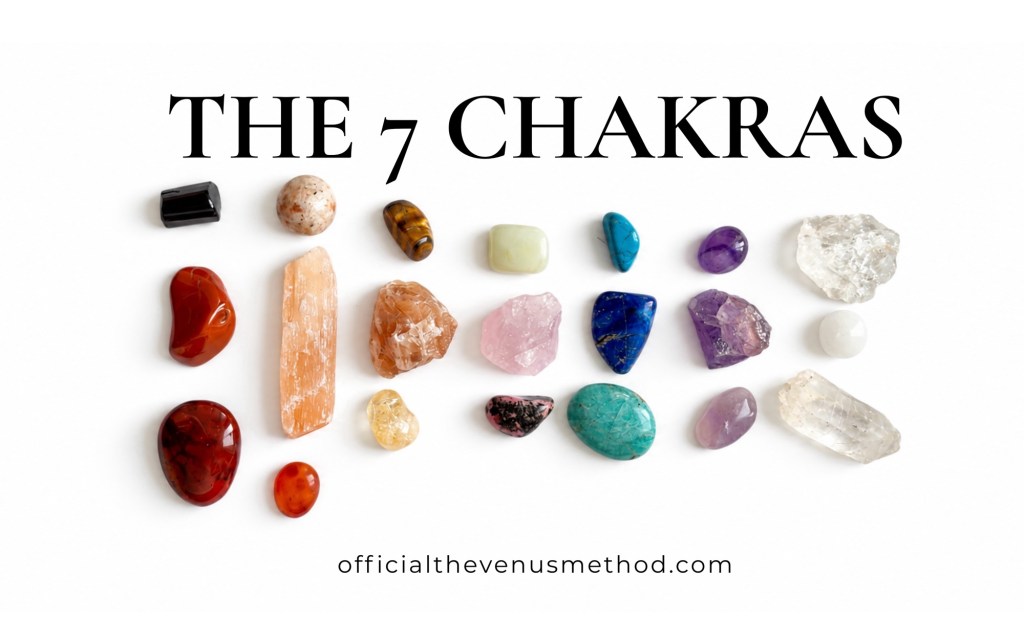
Chakras are often mentioned in the worlds of yoga, meditation and spiritual self-discovery. Safety, creativity, confidence, love, self-expression, intuition and spiritual connection: the widely used seven-chakra system associates these areas of life with different points in the body.
But what exactly is a chakra? Are there really seven? And how can we approach this system in a way that is understandable and connects with our own experiences?
What Is a Chakra?
The word “chakra” comes from the Sanskrit term cakra, meaning wheel or circle. In yogic and tantric traditions, chakras are described as energy centers in the subtle body and as focal points for meditation. They are often depicted as lotus flowers or wheel-like forms.
In these teachings, the subtle body refers to the energetic dimension of a person that extends beyond the physical body. Related concepts include prana, or life force, and nadis, the channels through which energy flows. Chakras are also understood as meeting points of these channels.
How Many Chakras Are There?
The seven-chakra system distinguishes seven main chakras, extending from the base of the spine to the crown of the head.
Traditions vary, however: there are systems that work with five, six, seven or twelve centers, among others. Some descriptions distinguish six chakras and a crown center above them. For this reason, it is more accurate to say that this article introduces the seven-chakra system.
The color associations below belong to the system widely used today. Older texts may describe different colors and details. Psychological explanations centered on safety, self-worth and relationship patterns are also largely part of modern interpretations.
1. Root Chakra – Muladhara
Described location: The base of the spine and the perineal region.
Modern color association: Red.
Element: Earth.
Main themes: Safety, stability, basic needs and a sense of belonging.
Associated crystals: Red jasper, black tourmaline and hematite.
The root chakra symbolizes our foundations. It is associated with the earth, the body and the supportive structures of everyday life. The stability connected with it expresses the experience of having something to rely on.
From a self-reflection perspective, we can connect this theme with our relationship to home, financial security and predictability. It invites us to notice how present we feel in our bodies, whether we recognize our basic needs and whether we make room for rest.
In everyday life, a quiet walk, consciously noticing the ground beneath our feet or reflecting on our daily rhythm can bring this theme closer to our experience.
Self-reflection question: What gives me a real sense of safety in my life, and what do I need right now to feel more stable?
2. Sacral Chakra – Svadhisthana
Described location: The lower abdomen and pelvic region, below the navel.
Modern color association: Orange.
Element: Water.
Main themes: Emotions, creativity, pleasure, sensuality, sexuality and intimacy.
Associated crystals: Carnelian, sunstone and orange calcite.
The water associated with the sacral chakra symbolizes flow and adaptability. This perspective makes room for experiencing emotions, creating and receiving the pleasures of life.
This theme extends beyond sexuality. It can also relate to recognizing our desires, our relationship with pleasure and creative self-expression. In self-reflection, we might explore whether we allow ourselves to enjoy things or expect every activity to produce an achievement.
We can engage with this theme through dance, freely creating something or writing about our feelings. Modern approaches that explore feminine energy often emphasize this center, but the seven-chakra system is not exclusive to women.
Self-reflection question: What brings me joy when I have nothing to prove?
3. Solar Plexus Chakra – Manipura
Described location: Around the navel; modern illustrations often place it in the upper abdomen, near the solar plexus.
Modern color association: Yellow.
Element: Fire.
Main themes: Confidence, willpower, decisions, action and personal boundaries.
Associated crystals: Citrine, pyrite and tiger’s eye.
Manipura is associated with inner strength and transformation. Its fire symbolism represents drive, courage and action directed toward our goals.
Through self-reflection, we can explore our relationship with our own decisions. Do we dare to choose? Can we say no? How much room do we give to other people’s expectations?
Both consistency and flexibility can have a place in expressing personal strength. Setting an achievable goal, making a decision we have been postponing or clearly stating a boundary can provide a tangible starting point for exploring this theme.
Self-reflection question: Which decision am I postponing because I am waiting for someone else’s approval?
4. Heart Chakra – Anahata
Described location: The center of the chest.
Modern color association: Green, or pink in some modern illustrations.
Element: Air.
Main themes: Love, compassion, acceptance, grief and connection.
Associated crystals: Rose quartz, green aventurine and rhodonite.
The heart chakra is associated with giving and receiving love. The compassion connected with it also extends toward ourselves: it relates to how we treat ourselves during difficult periods.
Both joy and loss can have a place within this theme. Connection can include allowing ourselves to feel sadness, asking for help or recognizing which relationships offer mutual appreciation.
Boundaries also have a place alongside love. We can understand someone while choosing not to continue accepting behavior that hurts us.
Self-reflection question: Do I offer myself the same attention and compassion that I give to others?
5. Throat Chakra – Vishuddha
Described location: The throat region.
Modern color association: Light blue.
Element: Space, also called ether.
Main themes: Communication, honesty, self-expression and attentive listening.
Associated crystals: Lapis lazuli, aquamarine and sodalite.
The throat chakra symbolizes finding our own voice. Alongside spoken words, this theme includes silence, receptivity and creative expression.
Through self-reflection, we can notice how clearly we express our needs. Do we speak up when something feels uncomfortable? Can we ask for what we need? Can we hear what another person is saying without immediately preparing our reply?
Writing, singing or organizing our thoughts before a conversation can provide ways to explore this theme. We can begin with a single sentence that clearly expresses what we need.
Self-reflection question: What would I like to say that I have repeatedly kept to myself?
6. Third Eye Chakra – Ajna
Described location: The area between the eyebrows.
Modern color association: Indigo.
Main themes: Intuition, inner attention, insight and clarity.
Associated crystals: Amethyst, lapis lazuli and labradorite.
The third eye symbolizes inner vision. Modern interpretations associate it with intuition, mental clarity and recognizing patterns.
In self-reflection, we can explore the stories we tell ourselves and how our expectations shape what we notice. Alongside exploring intuition, there is also room to check our impressions: a strong feeling alone does not prove that we have judged a situation accurately.
Quiet observation or journaling can help us consider what we actually experienced and what we inferred from it.
Self-reflection question: What do I know for certain about this situation, and what am I only assuming?
7. Crown Chakra – Sahasrara
Described location: The crown of the head, or in some traditions, the space above it.
Modern color association: Violet or white.
Main themes: Awareness, spirituality, a sense of oneness and the deeper meaning of life.
Associated crystals: Amethyst, selenite and clear quartz.
The crown center is often depicted as a thousand-petaled lotus. Spiritual teachings associate it with higher consciousness and connection beyond the individual self.
What this means personally may vary according to our worldview. For some, it means a relationship with the divine; for others, a sense of belonging to life as a whole or reflecting on the meaning of existence.
From a self-reflection perspective, we can explore our values and what gives our lives direction. Silence, contemplation, meditation or prayer can provide a setting for this, in keeping with our own beliefs.
Self-reflection question: What gives deeper meaning to the way I live?
What Does Chakra Balance Mean?
In contemporary spiritual language, we often encounter the terms “blocked,” “underactive” or “overactive” chakras. These are interpretations within a particular teaching, not medical diagnoses. An emotion or a physical symptom cannot reliably establish that a chakra is “blocked.”
From a self-reflection perspective, balance can mean paying attention to our different needs. Alongside safety, there is room for pleasure; alongside action, connection; alongside self-expression, listening.
The seven centers can offer seven perspectives on the same person. There is no need to work with all of them at once: we can begin with the theme that speaks to us most right now.
Chakras and The Venus Method Approach
The Venus Method views body, soul and psyche as an integrated whole. Within this approach, the chakra system can provide a spiritual and self-reflective framework for exploring our relationship with our bodies, our feelings and the different areas of our lives.
As we learn about the seven main chakras, we can ask ourselves: where do we need more stability, joy, independence, compassion or honesty? We can look for answers in our own experiences and everyday decisions.


Leave a Reply